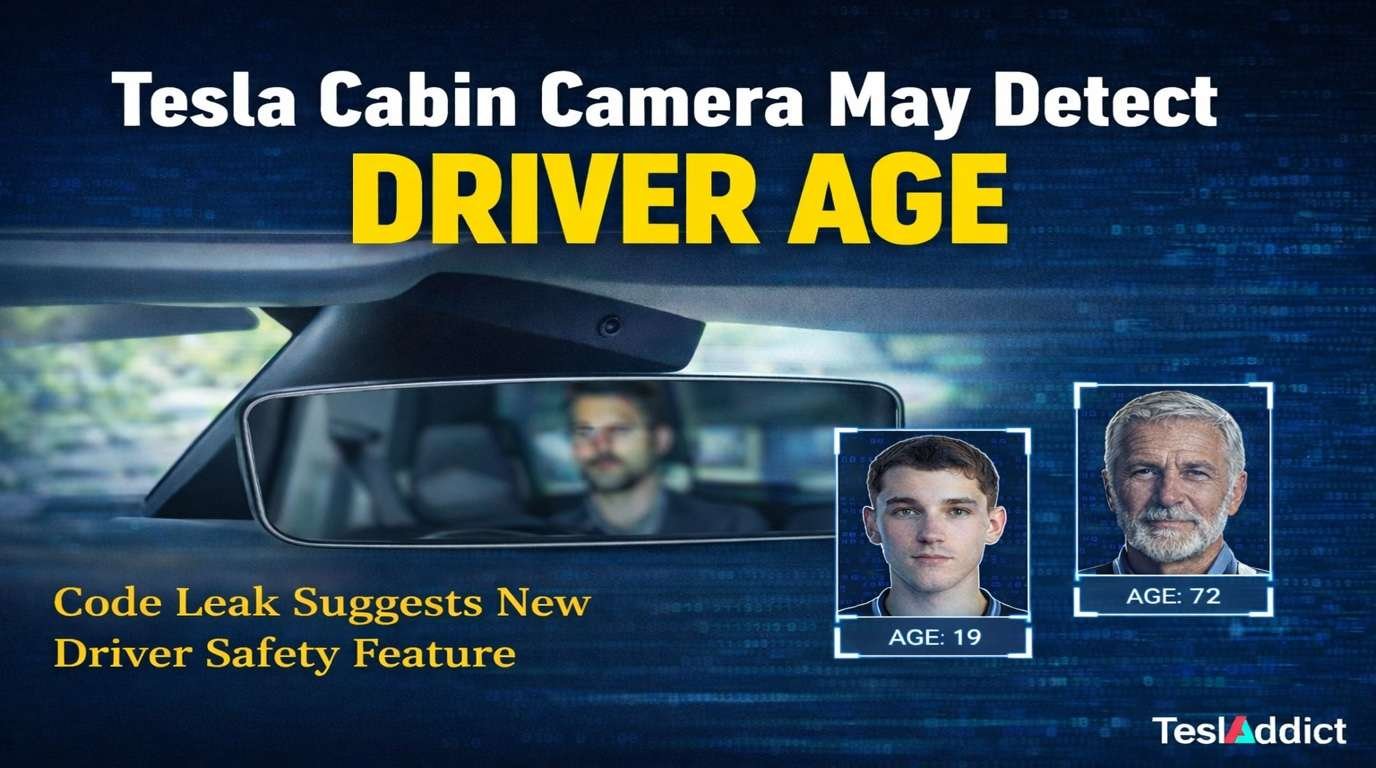
The rollout of Tesla Software Update 2026.8.6 has brought more than just the standard bug fixes and anti-dooring alerts found in the official release notes. Renowned Tesla hacker @greentheonly has unearthed hidden code within this version that allows the vehicle’s interior cabin camera to estimate the age of the driver. This move marks a significant evolution in Tesla’s Driver Monitoring System (DMS), shifting it from a reactive safety tool into a proactive identity and compliance guardian.
The Scoop
The discovery reveals that Tesla is quietly expanding facial analysis capabilities beyond simply tracking eye gaze or drowsiness. While currently dormant for the average user, the system is now capable of classifying facial features to approximate a driver’s age range. This feature is intended to act as an unannounced backend layer for Tesla’s upcoming autonomous and semi-autonomous services. By verifying the age of the individual behind the wheel—or in the passenger seat of a future Cybercab—Tesla can automate safety restrictions and regulatory compliance without requiring manual ID entry.
The Code Evidence
According to the technical breakdown of the 2026.8.6 firmware, the age-checking algorithm operates entirely on the vehicle’s local hardware to maintain user privacy. The system leverages the existing computer vision stack that powers the following features:
- Attentiveness Tracking: Real-time monitoring of eye gaze and head position to ensure the driver remains ready to intervene during FSD (Supervised) operation.
- Drowsiness Detection: The system analyzes facial cues like yawn frequency and blink rates, typically activating at speeds above 40 mph (65 km/h) after approximately 10 minutes of manual driving.
- Local Neural Processing: Age estimation data is processed on-board and is only shared with Tesla’s servers if the owner has opted into data sharing or if a safety-critical event is triggered.
The inclusion of this code coincides with the recent spotting of 60 Cybercab units at Giga Texas, suggesting that the software is being primed for a fleet that must manage passengers of all ages without a human steward present.
The Real World Impact
The implementation of age verification will fundamentally change the ownership experience, particularly for families and multi-driver households across North America. In Ontario or the GTA, where insurance rates for younger drivers are a significant factor, this technology could offer a “Parental Lock” feature that prevents teenagers from engaging high-performance modes or Full Self-Driving without supervision. Conversely, the vehicle could detect an elderly driver and automatically adjust FSD behaviors to provide more conservative acceleration and braking profiles to enhance comfort.
For the upcoming Robotaxi network, this code is the technical “gatekeeper” required to enforce Tesla’s updated Terms of Service, which now allow children as young as 8 to ride if accompanied by an adult. By verifying the age of occupants, the Cybercab can ensure it doesn’t leave the curb if an unsupervised minor attempts to hail a ride. For owners looking to maximize their vehicle’s interior privacy while these systems evolve, a high-quality physical camera cover remains a popular secondary safety measure.