
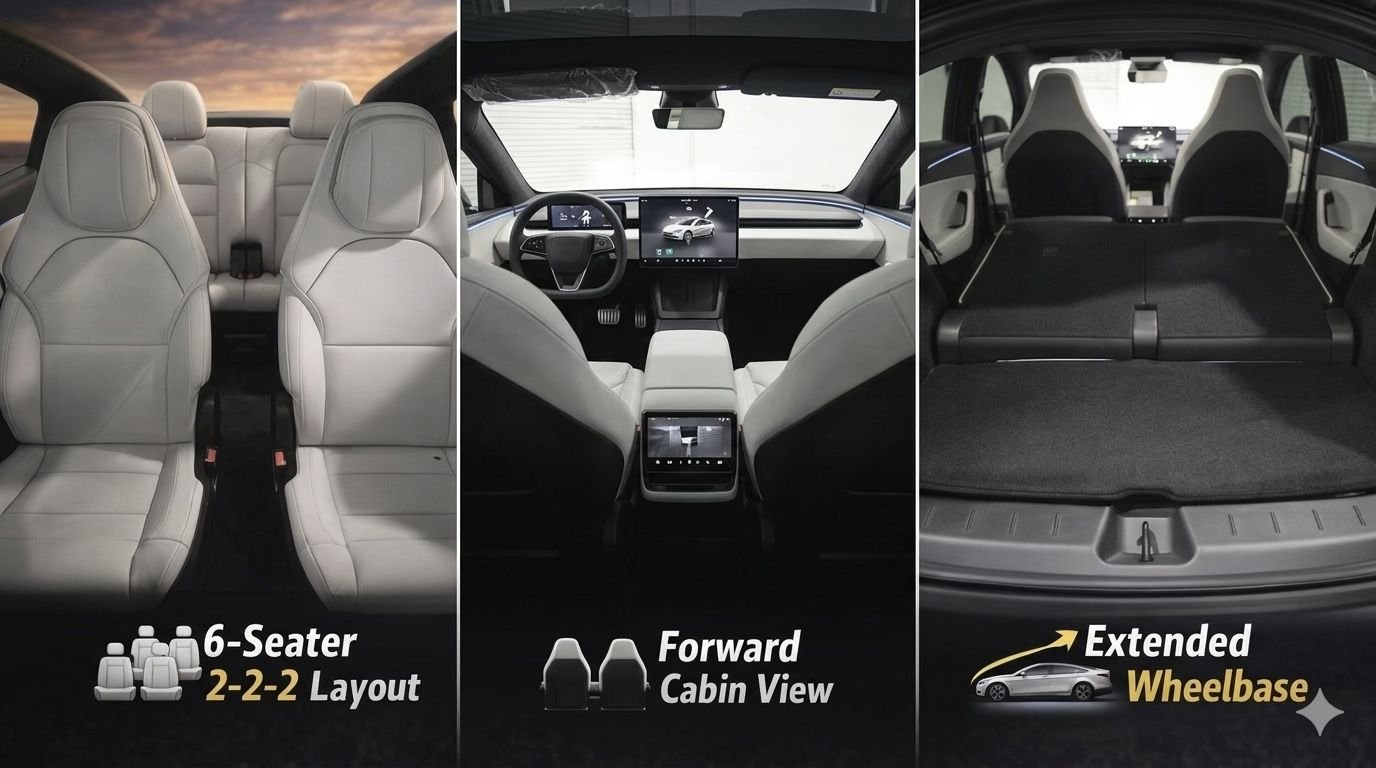
For years, North American families have tried to squeeze into the optional, cramped third row of the standard Model Y. Now, international markets are getting a first look at the actual solution. Dubbed the Model Y ‘L’, this newly stretched variant has begun quietly rolling out across Asia and Oceania. While it looks virtually identical to the standard crossover at first glance, the engineering changes behind the B-pillar represent a massive shift in Tesla’s fleet strategy.
Here is the data-driven breakdown of what the Model Y ‘L’ brings to the table, and what it means for the North American market.
The Dimensional Shift
Tesla did not simply bolt a third row into the existing cargo space. To make the 6-seat configuration viable, the entire footprint of the vehicle has been extended.
• The wheelbase has been stretched by 5.9 inches (150 mm), entirely altering the cabin dynamics.
• The overall vehicle length grows by roughly 7 inches (178 mm).
• The interior drops the standard bench in favor of a 2-2-2 layout, featuring dedicated second-row captain’s chairs.
This added length directly translates to actual legroom. Access to the third row is no longer an acrobatic feat, and while it will not rival a full-size minivan, it fundamentally bridges the gap between the compact standard Model Y and the flagship Model X. For growing families needing to navigate tight urban parking in cities like Vancouver or sprawling suburban lots in Dallas, this slightly elongated footprint is the ideal compromise.
Performance and Range Realities
Adding length and a third row introduces extra weight, which historically kills EV efficiency. However, the Model Y ‘L’ retains Tesla’s highly efficient dual-motor all-wheel-drive architecture, producing roughly 450 to 500 horsepower.
The vehicle achieves a 0 to 60 mph sprint in approximately 5.0 seconds. While it lacks the brutal acceleration of a Performance trim, it remains quicker than almost any comparable internal combustion SUV in its class. On the range front, international testing yields around 423 miles on the optimistic WLTP cycle. When this model eventually crosses the ocean and faces standard EPA testing, expect a highly realistic 300 miles (480 km) of range. For owners dealing with deep winter voltage sag on the highways of Ontario or the mountain passes of Colorado, this solid baseline range is critical.
Bridging the North American Gap
The pricing data from early Asian markets is perhaps the most compelling detail. Converted from its launch price in the Philippines, the Model Y ‘L’ sits around $46,700 USD (roughly $63,500 CAD). This places it aggressively close to the standard Long Range pricing.
If Tesla’s Fremont or Texas Gigafactories adopt this architecture for North America, it signals a strategic pivot. With the Model X seeing reduced development focus and a high price tag, the Model Y ‘L’ steps in as the accessible family hauler. The extra wheelbase also smooths out the ride quality over broken pavement, addressing one of the most common complaints about the standard Model Y suspension.
Preparing for the Expanded Cabin
When transitioning to a 2-2-2 configuration, protecting the interior becomes slightly more complex due to the center aisle between the captain’s chairs. Standard floor mats will leave the high-traffic middle section exposed to snow, salt, and mud. For full coverage in multi-row EVs, you will want a unified, laser-measured solution that protects the tracks and the aisle.
Tesla’s international rollout of the Model Y ‘L’ proves that the company recognizes the spatial limitations of its best-selling vehicle. As the automotive world waits to see if this longer wheelbase merges with the upcoming “Juniper” refresh, one thing is certain: the era of the cramped crossover third row is ending.