⚡ The Quick Take:
• The Brains and Brawn: Tesla and xAI are launching “Digital Optimus,” an initiative integrating xAI’s Grok reasoning engine with Tesla’s AI4-equipped vehicles to handle complex, automated enterprise tasks.
• Distributed Computing: Instead of sitting idle, parked Teslas across North America will function as active compute nodes, processing real-time digital actions via a low-cost, background AI agent.
• Supercharger Evolution: Tesla will also deploy millions of dedicated Digital Optimus units at Supercharger stations, converting simple charging stops into a massive 7-gigawatt distributed computing grid.
Transforming the Daily Commute into a Computing Hub:
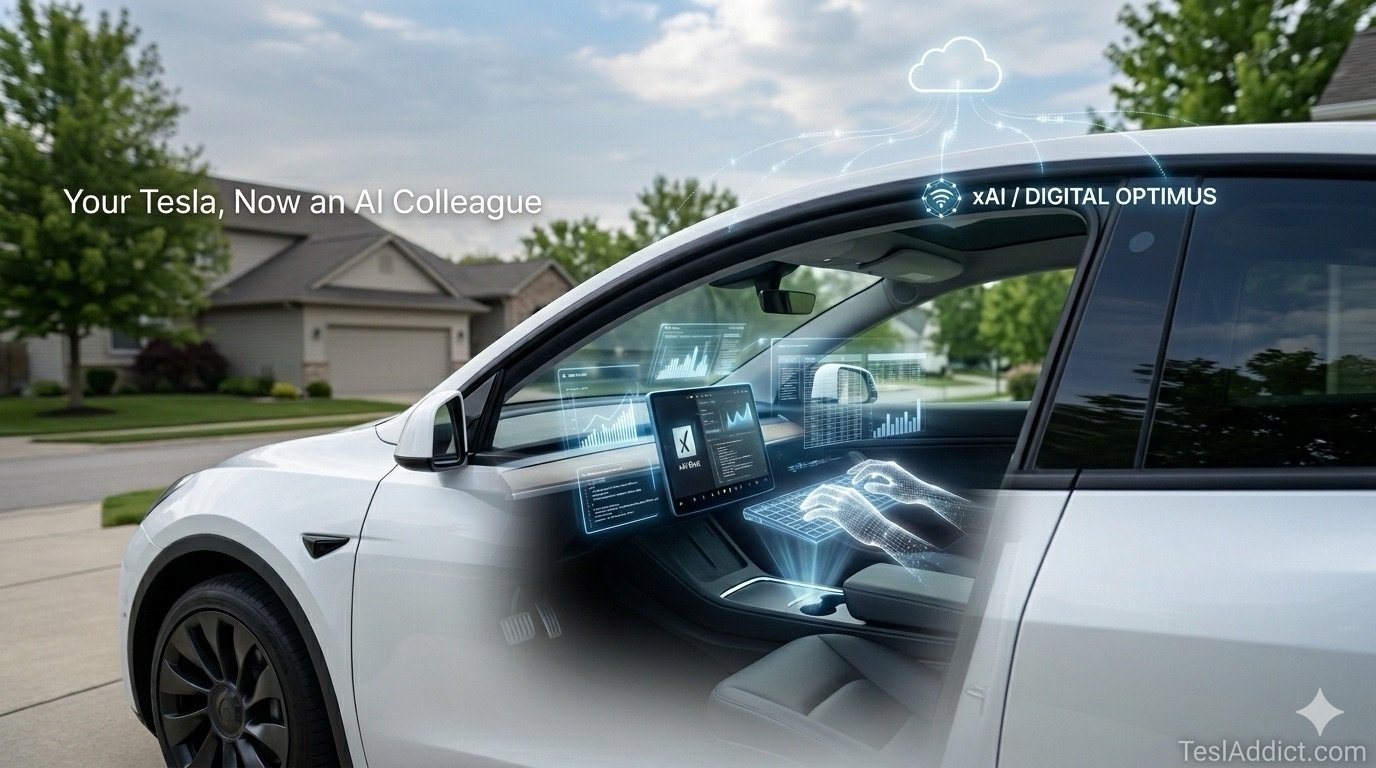
The rumors circulating the community are entirely accurate. Elon Musk recently confirmed one of the most ambitious joint projects between Tesla and xAI to date: “Digital Optimus” (also cheekily referred to internally as “Macrohard”). This upcoming software integration will effectively transform parked, AI4-equipped Teslas into distributed computing nodes capable of executing complex, automated office work.
How Digital Optimus Actually Works
Instead of just processing road data, Tesla is leveraging its massive fleet to conquer enterprise software tasks. The architecture relies on a brilliant two-tiered system:
• System 2 (The Brain): xAI’s Grok large language model acts as the high-level navigator, handling the reasoning, planning, and decision-making for tasks like invoice reconciliation or data entry.
• System 1 (The Hands): A Tesla-developed AI agent processes the past five seconds of real-time computer screen video, directing virtual keyboard and mouse actions with instinctive speed.
Your Parked Car as a Compute Node
Whether your Model Y is sitting idle in a driveway in the United States or parked at a workplace in Canada, its dormant AI4 hardware can be utilized as a remote data center node. Musk noted that this system will run competitively on Tesla’s low-cost AI4 chip, meaning your vehicle can actively crunch enterprise workloads in the background while you go about your day.
Transforming the Supercharger Network
Beyond the vehicles themselves, Tesla is fundamentally changing the purpose of its charging infrastructure. The company plans to deploy millions of dedicated Digital Optimus units directly at Supercharger stations. By tapping into the network’s roughly 7 gigawatts of available power, Tesla is turning simple charging stops into a massive, distributed AI computing grid.
What This Means for Owners
Musk is targeting an aggressive timeline, aiming for Digital Optimus to be ready for initial user experience within about six months (roughly September 2026). While your car handles the digital heavy lifting for major corporations in the background, you might want to get some actual work done while waiting at the Supercharger. Adding a sturdy Steering Wheel Desk Tray to your cabin is the perfect way to turn your driver’s seat into a practical physical workspace to match your car’s new digital capabilities.