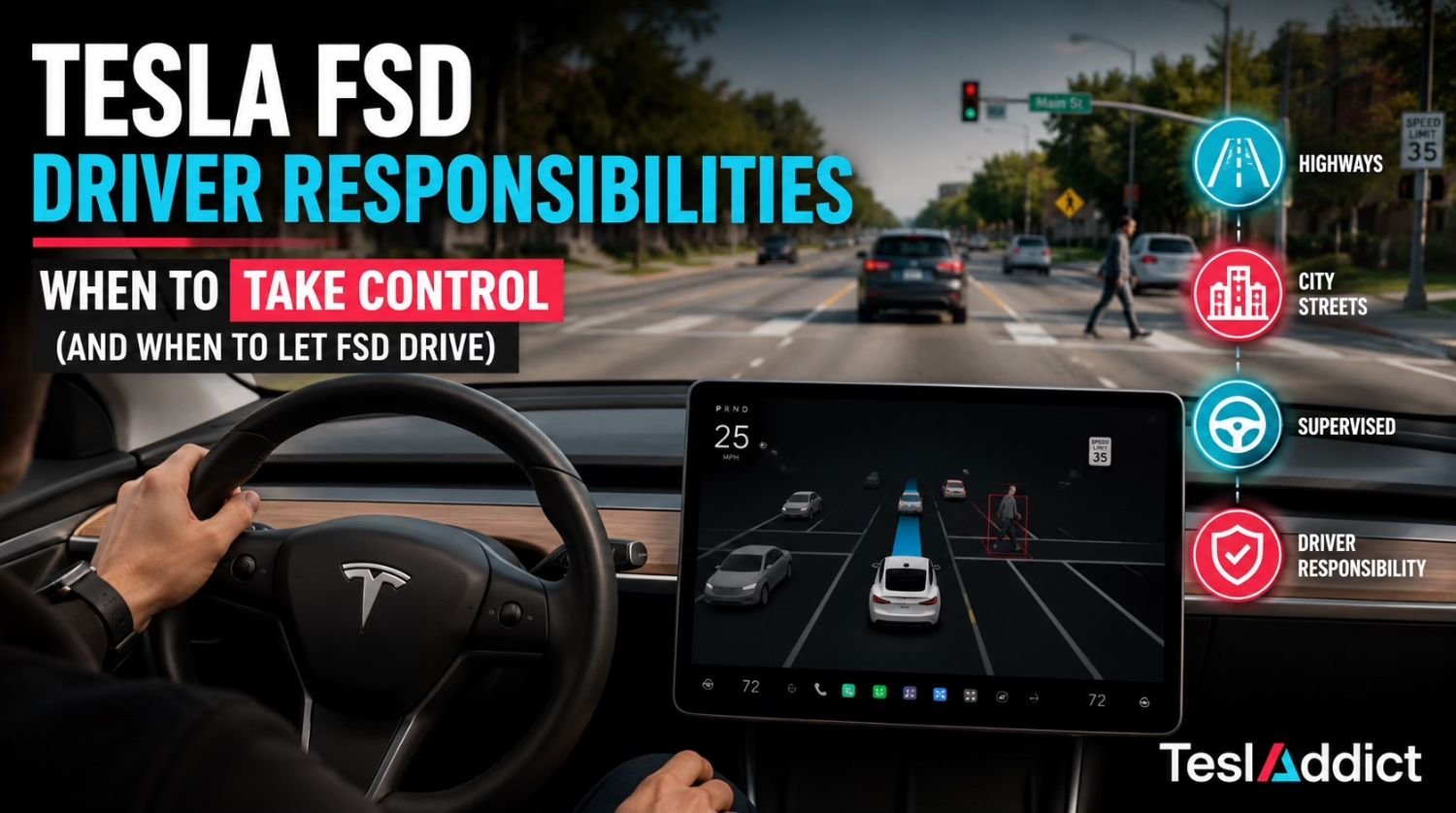
Tesla Full Self-Driving can steer through intersections, change lanes, merge onto highways, navigate roundabouts and follow a route with surprisingly little driver input.
But one question remains confusing for many owners:
When should you take control—and when should you allow FSD to finish what it is doing?
The confusion becomes more serious after an accident. In one case, the discussion may focus on why the driver did not intervene sooner. In another, the argument may be that the driver’s steering, braking or acceleration changed the vehicle’s path immediately before the collision.
Those positions can sound contradictory, but they address two different questions:
- Was intervention necessary before the dangerous situation developed?
- Once the driver intervened, did the timing or type of input affect what happened next?
There is no universal instruction to always let FSD continue or always grab the wheel at the first sign of uncertainty. The driver must continuously assess the situation and be prepared to intervene when necessary.
Quick takeaway: FSD (Supervised) is an advanced driver-assistance system, not a replacement for an attentive driver. You remain responsible for monitoring the road, recognizing unsafe behaviour and taking control early enough to avoid danger.
What “FSD Supervised” Actually Means
The word Supervised is the most important part of Tesla’s current Full Self-Driving name.
According to Tesla’s FSD (Supervised) guidance, the system can make lane changes, follow navigation routes, steer around vehicles and objects, and complete left and right turns. Tesla also states that these features do not make the vehicle autonomous or replace the driver.
Tesla’s owner documentation says the driver must pay attention to the road, surrounding traffic and other road users. It also instructs drivers to remain ready to take immediate action, particularly near intersections, blind corners and narrow driving situations.
In practical terms, supervision means you must:
- Watch the road rather than merely watching the touchscreen.
- Track vehicles, pedestrians, cyclists and potential hazards around you.
- Understand what FSD appears to be planning.
- Recognize when the system’s plan is becoming unsafe.
- Be physically and mentally prepared to take control immediately.
- Remain responsible for obeying traffic laws and road conditions.
Supervision does not mean waiting for the vehicle to issue a warning before acting. If you can already see a developing hazard, you should respond based on the road—not wait for FSD to recognize it.
The Most Important Rule: Do Not Wait Until the Last Possible Second
Drivers sometimes treat intervention as an emergency action that should happen only after FSD has clearly failed.
That is the wrong way to think about supervised driving.
A safer approach is to intervene when you reasonably believe the vehicle may no longer complete the manoeuvre safely. You do not need to wait until a collision is unavoidable.
For example, suppose FSD is approaching a construction area where lane markings suddenly disappear. The vehicle begins drifting toward temporary barriers while appearing uncertain about the intended path.
The driver should not wait to see whether FSD eventually corrects itself. Taking control early provides more time and space for a smooth correction.
Early intervention is usually safer than an aggressive last-second steering or braking input.
When You Should Let FSD Continue
FSD may perform some manoeuvres differently from the way you would drive manually. Different does not automatically mean dangerous.
You generally do not need to disengage merely because FSD:
- Waits slightly longer than you would at an intersection.
- Selects a different but legal lane.
- Changes lanes earlier than expected.
- Slows for a curve or uncertain situation.
- Leaves a larger following distance.
- Pauses before completing an unprotected turn.
- Abandons a manoeuvre and returns to its previous lane.
Constant unnecessary intervention can make the ride less predictable and prevent you from learning how the current FSD version behaves.
However, “let FSD continue” is appropriate only while the manoeuvre remains safe, legal and understandable.
You should never let the system proceed simply because you are curious about what it will do.
When You Should Take Control Immediately
Take control whenever you believe FSD is creating—or is about to create—an unsafe situation.
Common warning signs include:
- The vehicle begins entering an occupied lane.
- FSD does not appear to recognize a pedestrian or cyclist.
- The vehicle approaches stopped traffic too quickly.
- It selects an incorrect lane near an intersection.
- It appears confused by construction cones or temporary markings.
- The chosen speed is unsafe for weather, visibility or road conditions.
- The vehicle moves toward a curb, median, barrier or road edge.
- FSD fails to respond appropriately to an emergency vehicle.
- A police officer or construction worker is directing traffic manually.
- The vehicle approaches water, debris, an open gate or another unusual obstruction.
- You cannot confidently determine what the system intends to do.
You do not need permission from the vehicle to take over. Driver intervention is always appropriate when required for safety.
FSD Takeover Decision Table
| Situation | Let FSD Continue | Take Control |
|---|---|---|
| Normal highway cruising with stable lane positioning | Yes, while monitoring | If positioning, speed or following distance becomes unsafe |
| Routine lane change with a clear adjacent lane | Yes, if the manoeuvre remains safe | If another vehicle enters the space or FSD misjudges the gap |
| FSD pauses longer than expected at an intersection | Usually, if the vehicle is safely stopped | If remaining stopped creates a hazard or traffic direction requires action |
| Unprotected left turn | If visibility and the available gap remain safe | If FSD begins entering an unsafe gap or cannot see approaching traffic |
| Roundabout | If lane selection, speed and yielding behaviour are correct | If FSD enters against traffic, selects the wrong lane or approaches too quickly |
| Construction zone with clear markings | Only with heightened supervision | If temporary lanes, workers or barriers create uncertainty |
| Heavy rain, snow, fog or glare | Only if visibility and road grip remain adequate | When conditions make the system’s speed or path unsafe |
| Police officer directing traffic | No | Take control and follow the officer’s directions |
| Emergency vehicle approaching | Only if FSD responds correctly and lawfully | If the vehicle does not yield promptly or safely |
| You are unsure what FSD is attempting | Do not wait merely to find out | Take control when uncertainty creates a safety concern |
Taking Control Does Not Always Mean Jerking the Steering Wheel
“Take over” can sound like a single action, but a driver may need to respond in different ways depending on the hazard.
Intervention may involve:
- Applying the brake.
- Steering away from a hazard.
- Using the accelerator when remaining stationary is unsafe.
- Cancelling an inappropriate lane change.
- Disengaging FSD and continuing manually.
The correct response depends on the immediate situation.
For example, if FSD begins moving toward an occupied lane, steering back into the original lane may be appropriate. If the vehicle is approaching stopped traffic too quickly, braking may be the more important first action.
Drivers should familiarize themselves with the disengagement behaviour of their specific vehicle and software version before relying heavily on FSD. Controls and feature behaviour can change through software updates, so the owner’s manual displayed in the vehicle should be treated as the primary reference.
Why an Intervention Can Sometimes Contribute to a Crash
The fact that drivers must remain ready to intervene does not mean every possible intervention is automatically safe.
A sudden steering, braking or acceleration input can alter the vehicle’s path at a critical moment. A driver may also misunderstand what the system is attempting and react in a way that introduces a new hazard.
Consider a highway lane change. FSD begins moving toward an apparently open lane. The driver becomes nervous and abruptly steers back without checking the original lane, where another vehicle has moved into the blind spot.
In that situation, the driver may have believed intervention was necessary, but the timing and direction of the intervention could still affect the outcome.
This is why safe supervision requires more than keeping a hand near the wheel. The driver should maintain enough situational awareness to understand:
- What FSD is doing.
- Why it may be doing it.
- Where surrounding vehicles are located.
- Which corrective action leaves the safest escape path.
The goal is not to avoid intervention. The goal is to make a controlled, informed intervention before the situation becomes critical.
Why Tesla’s Arguments After Different Crashes May Sound Inconsistent
Discussions about FSD-related collisions often become oversimplified on social media.
One post may say the driver should have taken over. Another may say the driver’s intervention caused or contributed to the crash. Without the complete vehicle data, video, road conditions and event timeline, those statements can appear contradictory.
However, investigators may need to examine several separate questions:
- Was FSD engaged before the incident?
- What did the vehicle detect?
- What path was the system attempting to follow?
- When did the driver recognize—or reasonably have the opportunity to recognize—the hazard?
- Did the driver brake, steer or accelerate?
- Did the input disengage or override part of the system?
- Was the intervention early and controlled, or late and abrupt?
- Could an earlier response have prevented the collision?
- Did the driver’s final input change the outcome?
It is therefore possible for an investigation to conclude that a driver should have intervened earlier while also finding that a later input contributed to the final vehicle movement.
That does not create a practical rule that drivers should avoid taking control. It reinforces the importance of continuous attention and early, deliberate intervention.
How FSD Handles Different Road Types
Highways
Highway driving is often one of the more predictable environments for FSD because traffic generally follows marked lanes in the same direction.
The system may navigate interchanges, maintain speed, follow traffic and complete lane changes. Drivers must still monitor:
- Fast-approaching vehicles from behind.
- Vehicles entering from short ramps.
- Motorcycles in blind spots.
- Stopped traffic beyond a curve.
- Construction lane shifts.
- Debris and disabled vehicles.
Do not assume that a clear lane on the touchscreen guarantees that the lane is actually clear.
City Streets
Urban roads create a much more complex environment. FSD may need to process traffic lights, parked cars, cyclists, pedestrians, buses and vehicles entering from driveways within seconds.
Intervene if the vehicle appears to misread a lane, crowd a cyclist, approach a pedestrian too closely or proceed despite obstructed visibility.
Residential Roads
Residential streets may appear easy, but they often contain unpredictable hazards such as children, pets, delivery vehicles and cars backing out of driveways.
Keep the speed appropriate for what you can actually see. Take control if FSD travels faster than the environment safely allows—even when the displayed speed limit is higher.
Rural Roads
Rural routes can include faded markings, narrow shoulders, sharp curves, farm equipment and animals entering the roadway.
Pay particular attention near blind crests and curves. A road can appear empty while hiding a slow vehicle or obstruction just beyond the visible area.
Roundabouts
FSD may navigate many roundabouts successfully, but the driver should verify the selected lane, entry speed and available gap.
Take control if the vehicle appears ready to enter without yielding, stops where another vehicle may not expect it or begins exiting into the wrong lane.
Unprotected Left Turns
Unprotected turns require the vehicle to judge traffic speed, distance and available gaps.
A cautious pause is not necessarily a reason to intervene. Entering an unsafe gap is.
Be especially careful when parked vehicles, vegetation, snowbanks or road geometry block the view of approaching traffic.
Construction Zones
Construction areas are among the most important places to prepare for manual driving.
Temporary markings may conflict with older lane lines, while cones, workers and equipment can change position throughout the day.
Take control early if FSD follows obsolete markings, aims toward a closed lane or fails to respond to a flag person.
Parking Lots
Parking lots contain pedestrians, shopping carts, reversing vehicles and poorly defined driving paths.
Low speed does not eliminate risk. Closely supervise movement near storefronts, crosswalks, loading zones and parked vehicles.
Snow, Heavy Rain and Poor Visibility
Even when FSD remains available, the driver must decide whether conditions are suitable for its continued use.
Snow can hide lane markings and curbs. Rain can reduce camera visibility and increase stopping distance. Fog and glare can make objects harder to detect.
Take control when FSD’s speed, following distance or positioning no longer matches the conditions.
Common FSD Situations—and the Better Driver Response
FSD Brakes Unexpectedly
Possible mistake: Immediately pressing the accelerator without checking why the vehicle slowed.
Better response: Scan the roadway first. FSD may be responding to a pedestrian, merging vehicle, changing speed limit or uncertain object. Override only after confirming that acceleration is safe.
FSD Waits Too Long at a Turn
Possible mistake: Pressing the accelerator to force the vehicle into traffic.
Better response: Confirm that the gap is safe from the driver’s position. If you choose to proceed, be prepared to complete the entire manoeuvre manually.
FSD Starts an Uncomfortable Lane Change
Possible mistake: Abruptly steering back without checking the original lane.
Better response: Monitor both lanes and use a smooth correction if the destination lane is unsafe.
FSD Selects the Wrong Lane
Possible mistake: Waiting until the intersection to correct the route.
Better response: Take control early or allow the vehicle to continue legally and reroute. Never make a dangerous last-second lane change solely to remain on the planned route.
The Driver Does Not Understand What FSD Is Doing
Possible mistake: Allowing the manoeuvre to continue as an experiment.
Better response: If the uncertainty could create danger, take control while there is still enough space for a smooth response.
FSD Encounters an Emergency Vehicle
Possible mistake: Assuming the vehicle will automatically understand every local yielding requirement.
Better response: Identify a safe place to yield and take control if FSD does not respond promptly and lawfully.
A Police Officer Waves Traffic Through a Red Light
Possible mistake: Waiting for FSD to decide whether to proceed.
Better response: Take control and follow the officer’s instructions when safe to do so.
The Difference Between Readiness and Unnecessary Intervention
Being ready to take over does not mean constantly fighting the system.
A properly supervising driver should be able to let FSD complete routine, safe manoeuvres while maintaining the awareness needed to intervene immediately.
Think of readiness as maintaining an escape plan:
- Know where surrounding vehicles are.
- Keep your feet positioned so you can brake or accelerate when necessary.
- Keep your hands available for steering.
- Watch beyond the vehicle directly ahead.
- Identify potential hazards before FSD reaches them.
The safest intervention often begins several seconds before a dangerous event—not in the final fraction of a second.
Golden Rules for Every FSD Driver
- You are still the driver. FSD does not transfer responsibility for operating the vehicle.
- Watch the road, not just the visualization. The touchscreen is supplementary information, not a substitute for direct observation.
- Intervene based on safety—not curiosity. Do not let an unsafe situation continue simply to test what FSD will do.
- Take control early. Smooth corrections are generally safer than last-second reactions.
- Do not override blindly. Understand surrounding traffic before steering, braking or accelerating.
- Expect limitations in unusual environments. Construction, emergency direction, severe weather and unclear markings require heightened attention.
- Reassess after every update. A new software version may behave differently from the version you previously learned.
- Disengage when you cannot supervise properly. Fatigue, distraction or poor visibility are reasons to drive manually—or stop driving.
FSD Driver Responsibility Checklist
| Before Engaging FSD | While FSD Is Driving | When Taking Control |
|---|---|---|
| Confirm cameras are unobstructed | Watch the road and surrounding traffic | Identify the safest corrective action |
| Check weather and visibility | Track pedestrians and cyclists | Use smooth steering or pedal input when possible |
| Understand the planned route | Anticipate construction and unusual road conditions | Continue driving manually until the situation is stable |
| Adjust the maximum speed appropriately | Keep hands and feet ready to respond | Do not immediately re-engage without reassessing |
| Avoid engaging when tired or distracted | Intervene before the situation becomes critical | Report repeatable safety concerns when appropriate |
Frequently Asked Questions
Is Tesla FSD fully autonomous?
No. Tesla describes the consumer system as Full Self-Driving (Supervised). Tesla states that its driver-assistance features do not make the vehicle autonomous or replace the driver.
Am I legally responsible while using FSD?
FSD Supervised does not remove the human driver from the driving task. Traffic laws, insurance rules and legal responsibility can vary by jurisdiction and by the facts of an incident. Drivers should not assume that engaging FSD transfers responsibility to Tesla.
Should I take control whenever FSD makes me uncomfortable?
Discomfort alone may come from FSD driving differently from you. Evaluate whether the manoeuvre is safe, legal and predictable. Take control whenever your uncertainty reflects a genuine safety concern.
Can taking control make a situation worse?
Any abrupt steering, braking or acceleration can affect the vehicle’s path. That is why drivers should remain aware of surrounding traffic and intervene early enough to make a controlled correction. This does not mean you should avoid taking over when safety requires it.
Should I wait for an FSD warning before intervening?
No. If you see a developing hazard, respond based on the road situation. A driver should not wait for the vehicle to recognize or announce a danger that is already visible.
Should I let FSD complete every lane change?
No. Let the system continue only while the destination lane remains clear and the manoeuvre is safe. Cancel or override the lane change when traffic conditions change or the selected gap is unsafe.
What should I do after taking control?
Stabilize the vehicle and continue driving manually until the immediate situation has passed. Do not rush to re-engage FSD before confirming that the road, route and surrounding traffic are suitable.
Does the cabin camera replace steering-wheel monitoring?
The cabin camera may be used to monitor driver attentiveness, depending on the vehicle and software configuration. It does not eliminate the driver’s obligation to watch the road and remain ready to control the vehicle.
Can I use my phone while FSD is engaged?
No. FSD Supervised requires an attentive driver. Phone use can prevent you from recognizing a hazard and intervening in time, and handheld device laws continue to apply.
Where should I check the latest FSD instructions?
Review the owner’s manual available on your Tesla touchscreen because it is matched to your vehicle, region and software configuration. Tesla also publishes current information through its Full Self-Driving (Supervised) support page.
The Bottom Line
The safest FSD driver is not the person who constantly grabs the steering wheel—and it is not the person who refuses to intervene because the system is supposed to drive.
It is the driver who continuously understands the traffic environment, anticipates hazards and recognizes when FSD’s plan is no longer safe.
Let FSD complete routine manoeuvres when they remain safe and predictable. Take control when the vehicle appears confused, chooses an unsafe path, fails to respond to a hazard or leaves you uncertain about whether the manoeuvre can be completed safely.
Being ready to intervene does not mean intervening unnecessarily. But when intervention is needed, it should happen early, deliberately and with full awareness of the vehicles and hazards around you.