Spend a few minutes in any Tesla owner group and you will eventually see the same debate:
“Is Supercharging bad for my battery?”
That question quickly turns into conflicting advice about charging to 80%, 90% or 100%, whether home charging is healthier, whether you should wait until the battery gets low before plugging in, and whether frequent Supercharging will destroy the battery.
Fortunately, Tesla now provides fairly clear guidance on most of these questions.
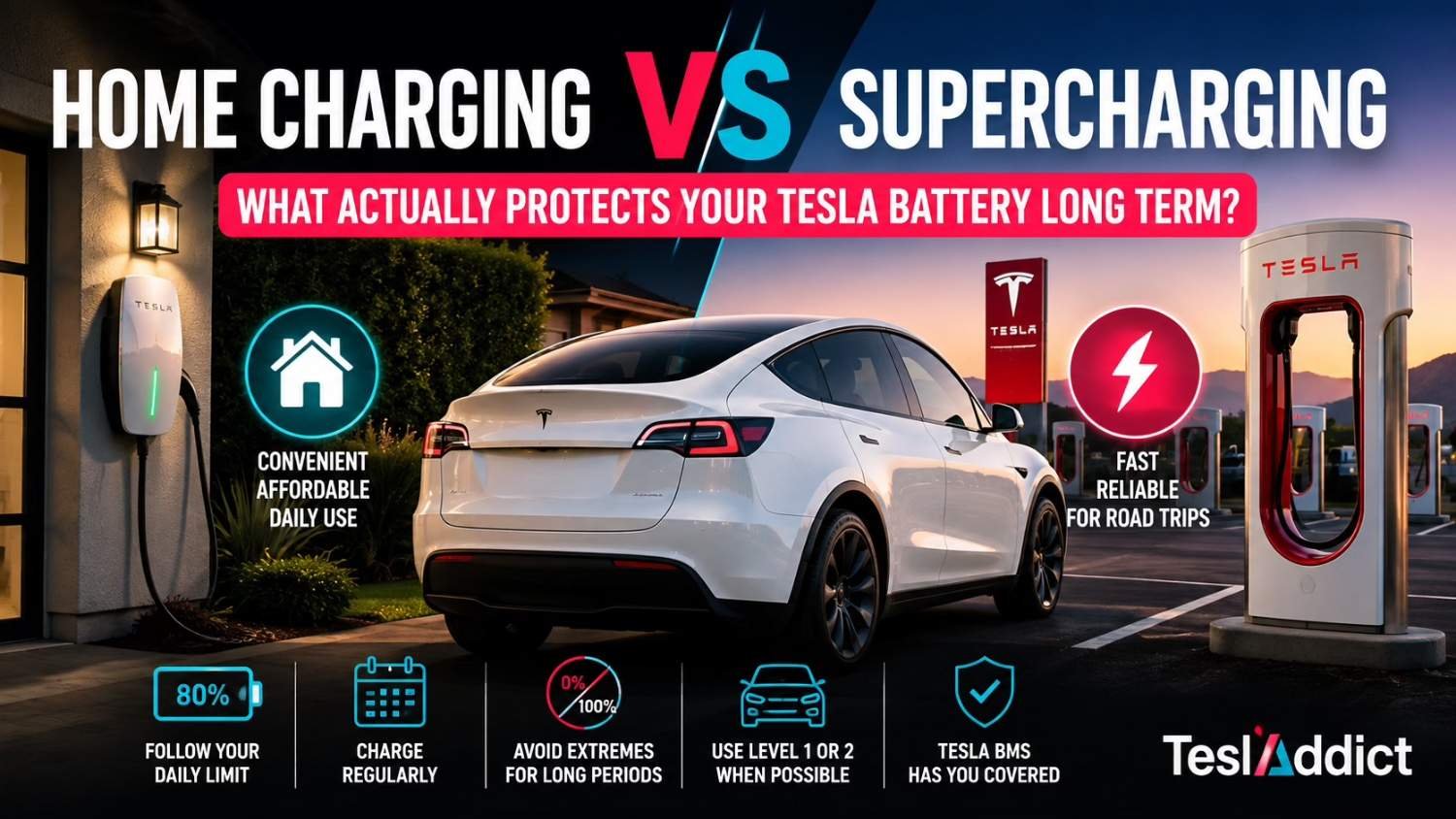
The simple answer: Use Level 1 or Level 2 home charging whenever practical, follow the daily charge limit shown by your Tesla, use Supercharging when you need it, and avoid leaving the battery sitting near 0% or 100% for extended periods.
Home Charging vs Supercharging: Quick Answer
| Question | Best Practice |
|---|---|
| Best everyday charging method? | Level 1 or Level 2 home charging when available |
| Is Supercharging safe? | Yes. Use it when needed, especially for road trips and long-distance driving. |
| Should I Supercharge every day? | Tesla recommends Level 1 or Level 2 charging whenever possible and saving Supercharging primarily for road trips or long drives. |
| Should I charge to 100% every day? | Follow the recommended daily charge limit displayed by your specific Tesla. For vehicles showing an 80% daily recommendation, Tesla says to reserve 100% primarily for longer trips. |
| Should I wait until the battery is low before charging? | No. Tesla says there is no advantage to waiting for a low state of charge and recommends charging regularly. |
| Is leaving the car at 100% ideal? | No. Tesla advises avoiding leaving the battery near 100% for long periods whenever possible. |
| Is leaving the battery near 0% okay? | No. Very low states of charge should also be avoided for extended periods. |
What Tesla Officially Recommends
Tesla’s current Model Y battery-care guidance is unusually specific.
Tesla recommends owners:
- Use Level 1 or Level 2 charging whenever possible
- Save Supercharging primarily for road trips or long drives
- Follow the recommended daily charge limit displayed by the vehicle
- Charge more frequently rather than routinely waiting for the battery to become very low
- Avoid leaving the battery near 0% or 100% for long periods whenever possible
- Keep the vehicle plugged in when practical, particularly during extended periods when it is not being driven
Read Tesla’s official High Voltage Battery Information →
Is Home Charging Better for Your Tesla Battery?
For everyday use, it is Tesla’s preferred approach.
Level 1 and Level 2 charging deliver energy considerably more slowly than DC fast charging. Tesla specifically recommends Level 1 or Level 2 charging whenever possible as part of its battery-longevity guidance.
Home charging also offers another major advantage: convenience.
Instead of repeatedly running the battery down and then filling it back up, you can simply plug the car in when you park.
Tesla actually recommends plugging in every evening to top off the battery and scheduling charging around lower electricity rates where available.
See Tesla’s official Home Charging recommendations →
Does That Mean Supercharging Is Bad for the Battery?
No. Supercharging is a normal part of Tesla ownership and the vehicle’s battery-management system controls charging based on factors including battery temperature, state of charge, battery condition and vehicle configuration.
But there is an important distinction between “safe to use” and “the preferred everyday charging method.”
Tesla explicitly says Superchargers are ideal for long-distance travel, while home charging options are available for daily commuting and local driving.
Tesla’s Model Y manual also notes that peak charging capability can decrease slightly after a large number of DC fast-charging sessions.
So there is little reason for an owner with convenient home charging to deliberately replace most Level 2 charging with Supercharging.
But there is equally little reason to be afraid of using a Supercharger when you actually need one.
Read Tesla’s official Supercharging guide →
Problem: “I Want My Battery to Last, So I Only Charge When It Gets Low”
Solution: Charge more regularly.
This is one of the most persistent habits carried over from older rechargeable electronics.
Tesla specifically states that there is no advantage to waiting until the battery level is low before charging. According to Tesla, the battery performs best when charged regularly.
In other words, you do not need to drive from 80% down to 10% before plugging your Tesla back in.
If you drive only 15% or 20% of the battery during the day, plugging back in that evening is perfectly normal.
Problem: “Should Every Tesla Be Charged to 80%?”
Solution: Follow the recommendation displayed by your own vehicle.
This is important because not every Tesla uses the same battery chemistry or charging recommendation.
Tesla says different batteries require different charging routines for optimal performance. Your touchscreen and Tesla app display the appropriate recommended charge limit for your vehicle.
If your Tesla recommends an 80% daily limit, Tesla’s guidance is straightforward: keep it around 80% for daily use and increase it to 100% when necessary, such as before a longer trip.
Do not blindly copy another owner’s charging percentage just because they also drive a Model Y or Model 3.
Your car’s displayed recommendation should take priority.
Problem: “Will Charging to 100% Damage My Tesla?”
Solution: Think about how long the battery remains full, not simply whether it ever reaches 100%.
Charging to 100% when you need the range is part of normal EV ownership.
For vehicles with an 80% recommended daily limit, Tesla specifically provides the ability to temporarily increase the charge limit above the daily recommendation for a trip.
The more important battery-care principle is avoiding leaving the vehicle sitting near 100% for extended periods whenever possible.
If you need maximum range for a road trip, scheduling charging so the vehicle reaches the desired level closer to departure is a sensible approach.
Problem: “Should I Supercharge to 100% on a Road Trip?”
Solution: Usually charge only as much as you need to comfortably reach the next destination or charging stop.
DC fast charging becomes progressively slower as the battery fills.
Tesla notes that reaching 100% at a Supercharger generally takes significantly longer than reaching 80%.
Tesla’s Trip Planner can calculate how much energy you need to reach the next charging stop, so stopping at 100% every time is usually unnecessary.
On many trips, leaving earlier and charging again later can be faster than waiting for the final portion of the battery to fill.
Problem: “I Only Have Access to Superchargers. Did I Make a Mistake Buying a Tesla?”
Solution: No—but understand the trade-offs.
A Tesla does not require home charging to function as an everyday vehicle.
Owners without home charging can rely on Superchargers, workplace charging, destination charging and other public charging networks.
The disadvantages of Supercharger-only ownership are primarily convenience, charging time, potentially higher energy costs and greater reliance on DC fast charging.
If Level 2 charging later becomes available at home, work or another frequently visited location, it generally makes Tesla ownership easier and aligns more closely with Tesla’s battery-care recommendations.
Problem: “Should I Leave My Tesla Plugged In Overnight?”
Solution: Yes, assuming you have appropriate home charging available.
Tesla’s Model Y manual says the most important way to preserve the high-voltage battery is to leave the vehicle plugged in when it is not being used, with particular emphasis on periods when the vehicle will not be driven for several weeks.
The vehicle manages charging automatically and stops adding significant energy once it reaches the configured charge limit.
You do not need to unplug the vehicle the moment it reaches your daily target.
Problem: “What If I Leave My Tesla Parked for Weeks?”
Solution: Tesla recommends a different strategy for long-term storage.
If the vehicle will remain stationary for more than roughly two weeks, Tesla recommends leaving the battery around 50%, setting the charge limit to approximately 50%, and keeping the vehicle plugged in if possible.
This reduces the amount of time the battery spends at a very high or very low state of charge.
What Happens to Regenerative Braking at 100%?
A fully charged battery has less capacity available to accept energy from regenerative braking.
Tesla therefore notes that regenerative braking can be limited when the battery is fully charged or cold.
On current Model Y vehicles, Tesla says the vehicle can automatically apply the regular brakes to provide consistent deceleration when regenerative braking is limited.
This does not mean charging to 100% is dangerous. It simply means there may be little or no battery capacity available to absorb regenerative energy immediately after departure.
Read Tesla’s regenerative braking documentation →
The Simple Tesla Battery Routine
For most Tesla owners, battery maintenance does not need to become a daily science experiment.
| Situation | Recommended Approach |
|---|---|
| Normal daily driving | Follow the daily charge limit displayed by your Tesla |
| Home charging available | Plug in regularly and use Level 1 or Level 2 charging |
| Long road trip tomorrow | Increase the limit when additional range is needed |
| Road trip underway | Use Superchargers normally and follow Trip Planner |
| Battery getting very low | Charge rather than intentionally running it toward 0% |
| Car sitting for weeks | Around 50%, plugged in if possible |
| Supercharging occasionally | Normal use—no reason to worry |
| Supercharging for nearly every charge | Use Level 1 or Level 2 charging instead when practical |
What About Battery Degradation?
Some battery degradation is normal for every lithium-ion EV battery. Maximum available range can gradually decrease as the battery ages and accumulates mileage.
That does not mean a small decline in displayed range indicates that the battery is failing.
Tesla’s current U.S. Battery and Drive Unit Limited Warranty includes minimum 70% battery-capacity retention during the applicable warranty period, although the mileage limit varies by model and configuration.
For current Model Y variants, battery warranty coverage can range from 8 years/100,000 miles to 8 years/120,000 miles depending on configuration.
Check Tesla’s current Battery and Drive Unit warranty →
Common Tesla Charging Myths
| Claim | Reality |
|---|---|
| “Supercharging destroys Tesla batteries.” | Misleading. Supercharging is designed into the vehicle, although Tesla recommends Level 1 or Level 2 charging whenever possible for battery longevity. |
| “You must run the battery low before charging.” | False. Tesla explicitly recommends regular charging. |
| “Every Tesla should always be set to 80%.” | False. Follow the charge recommendation displayed by your specific vehicle. |
| “You should never charge to 100%.” | False. 100% can be appropriate when additional range is needed; avoid unnecessarily leaving applicable batteries near 100% for long periods. |
| “Leaving a Tesla plugged in overnight damages it.” | False. Tesla recommends regular plug-in charging and manages charging automatically. |
| “Supercharger-only ownership makes owning a Tesla pointless.” | False. It is possible, although home or workplace charging is usually more convenient and often less expensive. |
So, Home Charging or Supercharging?
If you have home charging, use it as your primary charging source.
It is convenient, generally inexpensive, and consistent with Tesla’s own battery-care recommendations.
When you take a road trip or need energy quickly, use Superchargers without treating every DC fast-charging session as something harmful to your battery.
The mistake is turning battery preservation into an obsession.
Your Tesla already has a sophisticated Battery Management System controlling temperature, charging power and other battery parameters. Your job is much simpler: follow the charge limit displayed by the car, charge regularly, avoid prolonged extremes, and use the charging method that makes sense for the trip.
Related Reading
If you want to get more from your Tesla while keeping charging costs and battery health in perspective, these guides can help:
- How Much Does It Cost to Charge an EV? Use Our Charging Cost Calculator →
- EV vs Gas Savings Calculator: See How Much You Actually Save →
- Better Charger ROI Calculator: Is a Home EV Charger Worth It? →
Bottom Line
For everyday driving: Level 1 or Level 2 charging is the preferred choice.
For road trips: Supercharge when you need to.
For daily charge limits: Follow what your Tesla actually recommends rather than copying another owner’s percentage.
For 100% charging: Use it when the extra range is useful, but for vehicles with a lower recommended daily limit, avoid leaving the battery sitting full unnecessarily.
For low battery levels: Do not deliberately run the pack down before charging.
The best Tesla charging habit is ultimately a remarkably simple one: plug in regularly, follow the car’s recommendations, and drive.