
For everyday driving, follow the charge limit shown by your Tesla, use Level 1 or Level 2 charging when practical, and Supercharge when the trip requires it. Battery care is mainly about a consistent routine and avoiding prolonged extremes.
Follow your vehicle’s daily charge recommendation
Tesla batteries do not all have the same charging guidance. Use the limit displayed in your car or app rather than copying another owner’s percentage. For vehicles recommending about 80% daily, Tesla advises reserving 100% for trips that need the additional range.
Tesla’s Model Y battery-care guidance recommends regular charging, avoiding long periods near 0% or 100%, and leaving the vehicle plugged in when practical. There is no benefit to deliberately running the battery low before charging.
Use home charging for a convenient routine
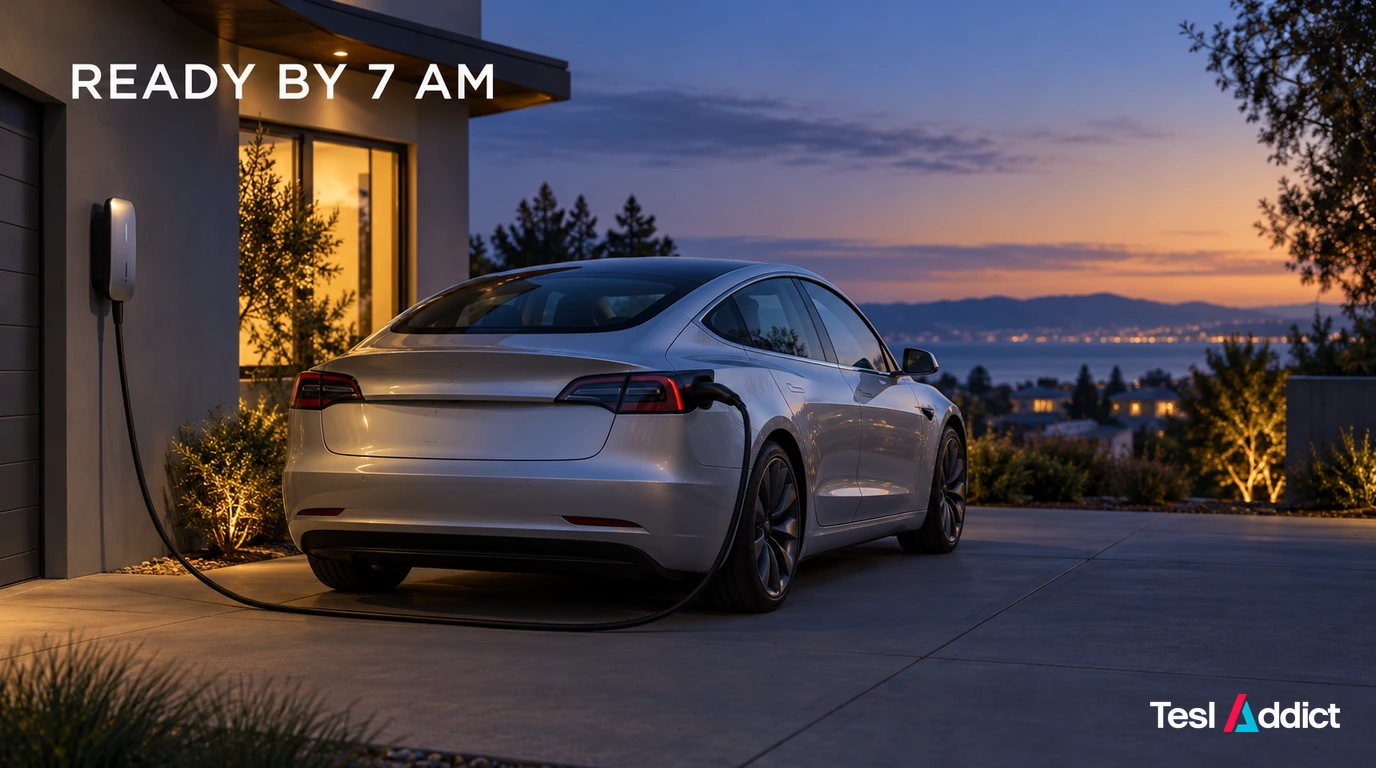
A suitable home or workplace AC supply lets you replace the energy used each day while parked. Tesla recommends Level 1 or Level 2 charging where possible. Its home-charging guidance also supports scheduling around lower electricity rates where available.
Compare the Autel AC Lite 40A and AC Elite 50A if you need a new home charger. Choose for your circuit and overnight driving needs; buying a higher-rated unit does not itself improve battery longevity.
Leave the car connected with the appropriate charge limit; you do not need to unplug it the moment it reaches the target. Compare the whole household tariff before switching plans, and do not replace a working charger merely to obtain scheduling already available in the vehicle.
Supercharge when you need it
Supercharging is part of normal Tesla use. The vehicle adjusts power for battery temperature, charge level and other conditions. Tesla notes that peak charging capability may decrease slightly after many DC fast-charging sessions; that is not a prediction that an occasional road trip will damage the battery.
Use Trip Planner to prepare for charging and estimate the energy needed for the next stop. Charging slows as the battery fills, so waiting for 100% at every stop is usually unnecessary. See Tesla’s Supercharging guidance.
Without home charging, assess nearby public, workplace and destination options by price, reliability and the time they add to your week. Public charging can support daily ownership; convenient Level 2 access is useful if it becomes available.
Adjust for trips and long-term parking
| Situation | Practical action |
|---|---|
| A trip needs a higher charge | Raise the limit as needed and aim to finish near departure rather than leaving the car full unnecessarily. |
| The car will sit for a long period | Follow the vehicle’s manual. Model Y guidance recommends around 50% and staying plugged in where possible. |
| The car must remain unplugged | Allow for energy used while parked; monitor charge and reduce optional parked features where appropriate. |
| The battery is very low | Charge promptly instead of deliberately approaching 0%. |
A full or cold battery can limit regenerative braking. Tesla describes the braking behaviour and, where equipped, friction-brake compensation in its Model Y braking documentation. Follow your vehicle’s indications and maintain a safe following distance.
Keep degradation and warranty in perspective
Battery capacity gradually changes with age and use; a small change in displayed range alone does not diagnose a failed battery. Tesla’s current warranty information describes minimum capacity retention and model-dependent time and mileage limits. Check the warranty that applies to your own vehicle and market.
To compare the cost of your routine, use our charging-cost calculator, EV versus gas calculator or home-charger cost comparison. The useful habit is simple: charge regularly, follow your car’s guidance and choose the charging stop that suits the journey.