
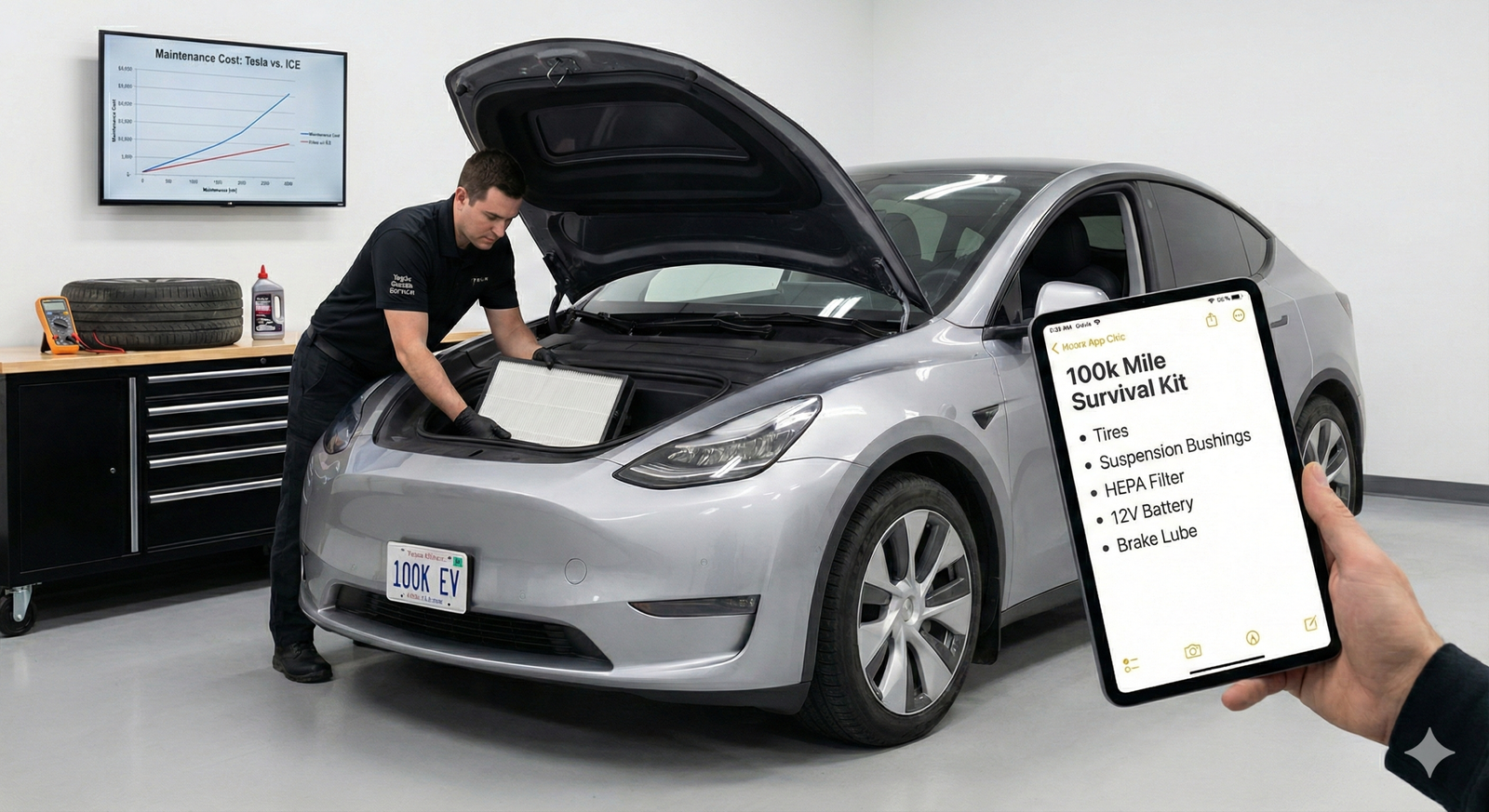
The 100k Threshold: What Actually Wears Out
In an electric vehicle, the powertrain is theoretically immortal, but the “wear items” are under significantly higher stress than their internal combustion counterparts.
Tires: The Silent Tax
Reality check: by 100,000 miles, you have likely already purchased three full sets of tires. The Model Y’s weight and aggressive torque profile chew through rubber. Expect 25,000–35,000 miles per set on OEM tires. By the 100k mark, you are likely looking at your fourth set.
Suspension: The "Tesla Lean"
By 100,000 miles, the front lower control arm bushings often develop what owners call “the squeak.” High-mileage Ys frequently experience toe-in issues that cause aggressive inner-tire wear. If your steering feels “loose” or you hear a bird-like chirp over speed bumps, the bushings have reached their limit.
Cabin & HEPA Filters
If the AC smells like old gym socks, you’ve waited too long. The Bioweapon Defense Mode (HEPA) filter is often neglected but is essential for protecting the HVAC blower motor from debris. At 100k, a full replacement of both the internal cabin filters and the massive HEPA unit under the frunk is mandatory for air quality and system longevity.
Data over speculation: Longevity is built into the chemistry.
Battery Degeneration Reality: LFP vs. NMC Packs
After five years and 100,000 miles, the “range anxiety” conversation shifts from “How far can I go?” to “How healthy is my pack?” Real-world fleet data provides a clear picture of the two primary battery chemistries.
NMC (Nickel Manganese Cobalt)
Found in Long Range and Performance models, these packs show a steeper initial drop—roughly 5% to 7% in the first 20,000 miles—before plateauing. At 100,000 miles, most owners report a total degradation of 10% to 12%.
LFP (Lithium Iron Phosphate)
Found in the RWD models, LFP is the longevity king. These packs are more resilient to 100% charging cycles. Data suggests LFP packs at 100,000 miles often retain 92% to 95% of their original capacity. However, they are more sensitive to extreme cold, showing higher voltage sag in sub-zero temperatures.
Winter-Specific Maintenance: Managing Salt and Seals
For those in “Salt Belt” regions, 100,000 miles is the critical threshold where neglect turns into permanent damage.
Brake Caliper Service
Because regenerative braking does 90% of the work, physical brakes rarely get hot enough to burn off moisture. In winter climates, annual cleaning and lubrication of calipers are non-negotiable. Without it, the sliders seize. At 100k miles, you might face a $2,000 brake job despite having 80% of your pad life remaining simply because the hardware rusted shut.
Door & Window Seals
Frameless glass is a winter liability. The rubber seals require periodic treatment with Krytox or P80 lubricant to prevent the glass from freezing to the seal, which can damage the window regulator motor.
The Undercarriage
Salt traps itself in the aero shields and battery casing gaps. High-pressure underbody flushes every two weeks during winter are the only way to prevent subframe corrosion over a five-year period.
The 'Hidden' Savings: Model Y vs. BMW X3 & Audi Q5
The 100k-mile cost comparison is where the Model Y wins on paper but faces a unique “quality of life” repair curve.
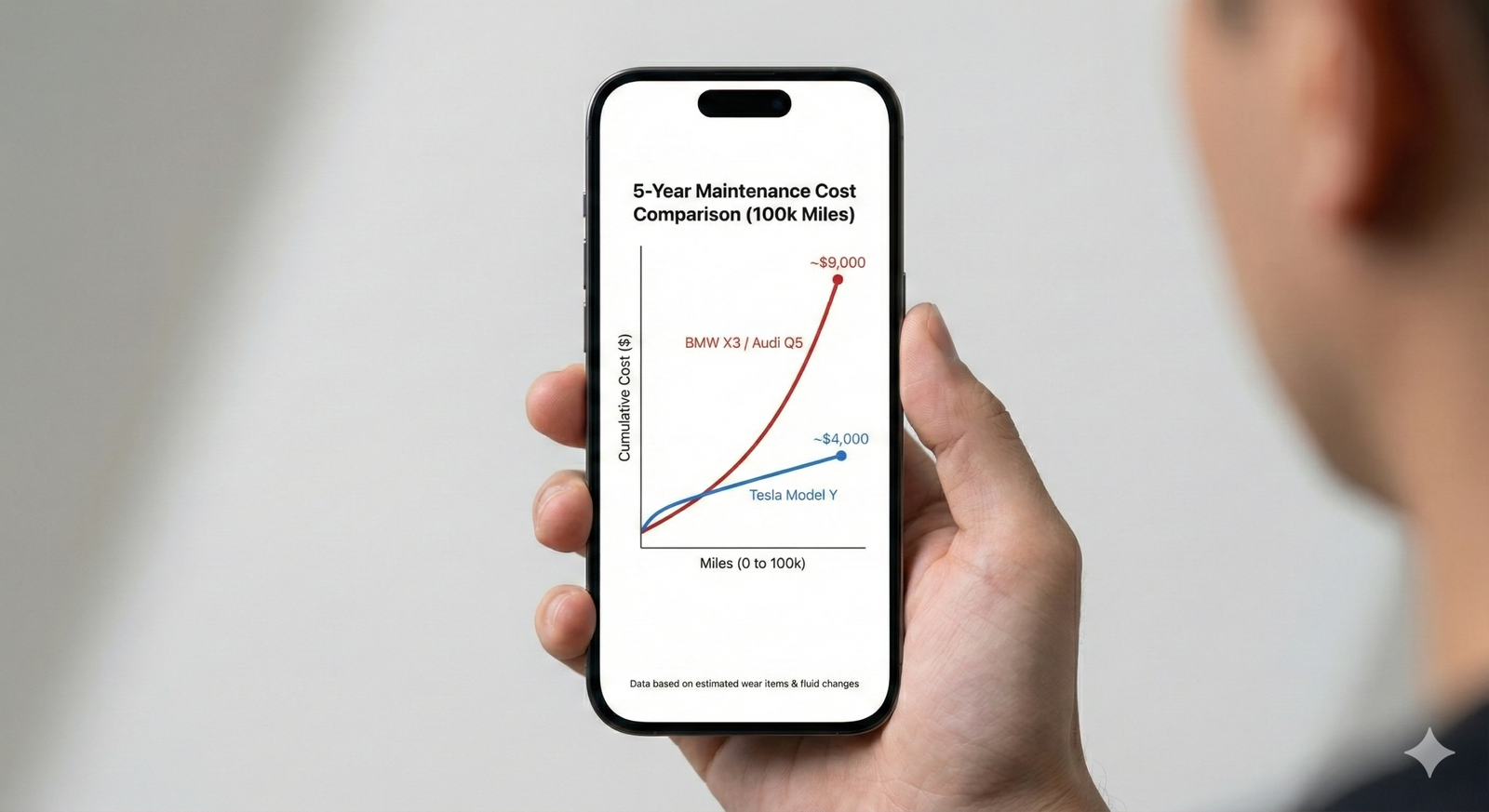
The "Hidden" Gap: The German luxury SUVs will require significant engine-related preventative maintenance by the 100k mark. The Tesla avoids these entirely. However, out-of-warranty Tesla hardware—such as a heat pump failure or an MCU glitch—can be expensive, often costing $2,000+ per incident. The savings are real, but they should be kept in a "rainy day" fund rather than spent.
Maintenance Cost Breakdown (100k Miles):
Tesla Model Y: ~$3,500 – $4,800 (Primarily tires, alignment, filters, and 12V battery).
BMW X3 / Audi Q5: ~$7,500 – $11,000 (Oil changes, transmission flushes, spark plugs, brake pads/rotors, and cooling system refreshes).
Pro Tip: Why Mobile Service is Your Best Friend
High-mileage upkeep should not require a trip to a sterile service center. Tesla’s Mobile Service is the “cheat code” for high-mileage owners.
Approximately 80% of the 100k-mile survival list can be handled in your driveway. Mobile technicians can replace the low-voltage battery (which typically dies every 3–4 years), swap HEPA filters, check brake fluid health, and even perform certain suspension calibrations.
Pro Tip: Use the Tesla App to upload photos of tire wear or record audio of suspension squeaks before the technician arrives. This ensures they have the correct control arms or bushings on the truck for a “one-and-done” repair.
The 100,000 Mile Survival Checklist
Tires: Inspect for “inner edge” wear, a classic sign of suspension misalignment.
Brakes: Perform a “Burnish” cycle in the service menu to clear surface rust; lubricate calipers if you live in a salt zone.
Filters: Replace both internal cabin filters and the external HEPA unit.
Low-Voltage Battery: If yours is older than 3 years, replace it proactively to avoid being stranded.
Coolant: While Tesla claims it is “life of the vehicle,” have a technician inspect the supermanifold for any signs of seepage.
Alignment: Conduct a professional 4-wheel alignment every two years to protect your tire investment.



Add comment